The Six Figure Myth
Anyone who spends time reading discussions within the Defense Industrial Base has probably encountered a concerning rumor:
Achieving CMMC Level 2 compliance requires rebuilding the entire corporate IT environment and spending six figures on enterprise software.
For small and mid-sized businesses—particularly machine shops, aerospace-parts fabricators, and specialized family-owned subcontractors—that rumor can become more than intimidating.
It can appear to create a financial barrier that threatens to push small businesses out of the government supply chain entirely.
But organizations do not necessarily need to rebuild their entire IT infrastructure from the ground up.
As Khanh Tran, CEO of Biorn Group Cyber, has explained on the Cuick 10 Podcast, a small family with a limited budget would not buy an oversized luxury vehicle designed for many more passengers than it needs.
The same principle can apply to cybersecurity architecture.
An organization should not purchase an environment designed for thousands of users when only a small number of people need to handle Controlled Unclassified Information.
By carefully defining the compliance boundary and evaluating whether a managed secure enclave fits the organization’s needs, small businesses may be able to strengthen CUI protection without disrupting every part of their daily operations.
Scoping: A Critical Cost-Control Tool
When preparing for CMMC Level 2 and the underlying NIST SP 800-171 requirements, scoping is one of the organization’s most important cost-control tools.
The applicable requirements generally focus on the systems, networks, facilities, and personnel that handle, store, or transmit CUI or support the protection of that information.
They do not automatically apply in the same way to every payroll system, marketing file, or general administrative process across the business.
For example, an organization may employ 50 people, but only several engineers and one executive may routinely handle military drawings, specifications, or related technical information.
If the applicable users and workflows can be clearly isolated, the organization may be able to create a smaller and more manageable security boundary.
When organizations apply specialized controls across the entire corporate network without first validating the scope, costs can increase quickly.
This expansion is sometimes referred to as boundary creep or over-scoping.
Working with an experienced Registered Practitioner Organization can help the business draw a clear and defensible boundary around relevant CUI workflows while avoiding unnecessary expansion into unrelated systems.
What Is a Secure Enclave?
Once the organization has narrowed its scope, it needs an appropriate environment for protecting CUI.
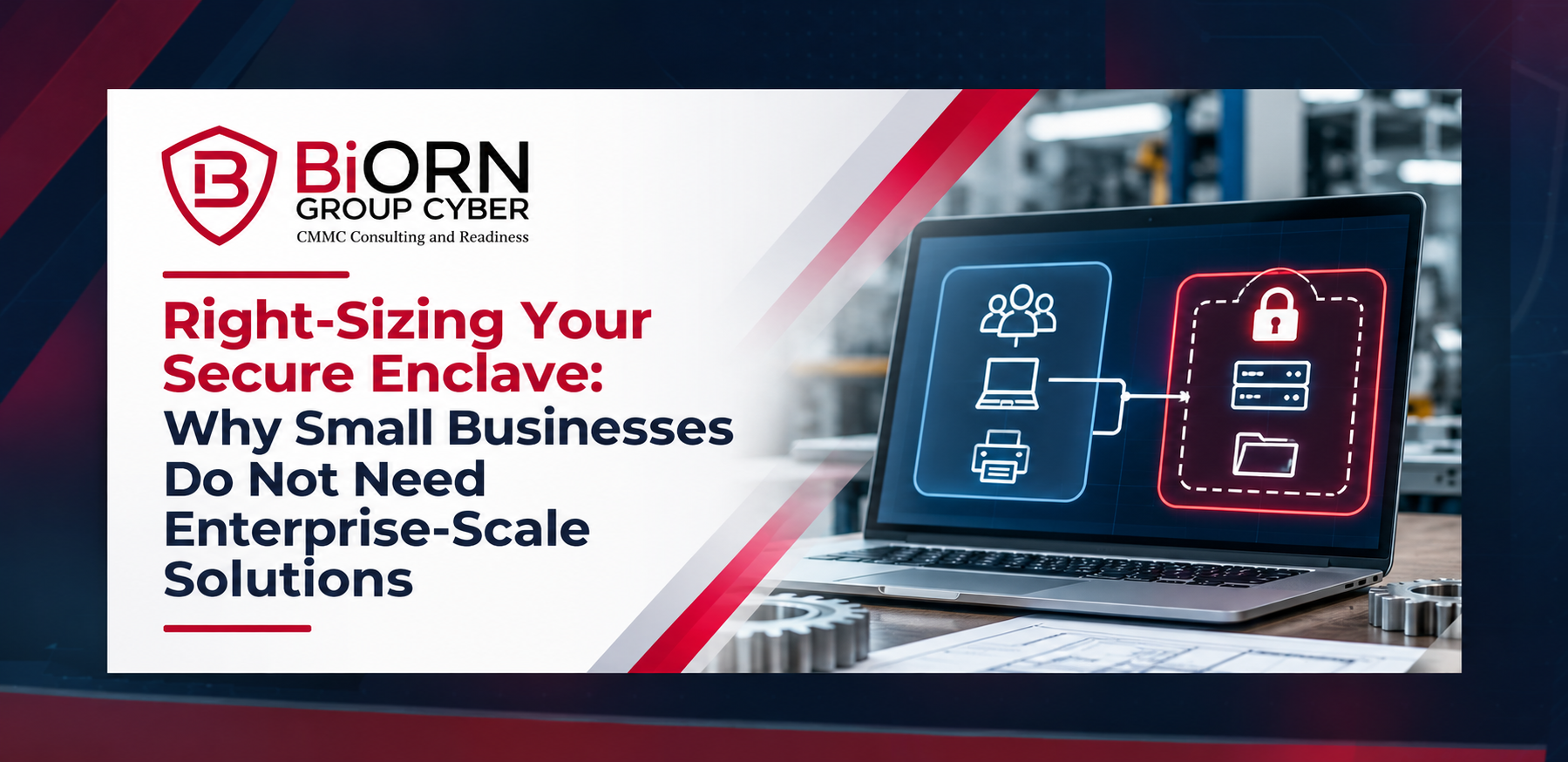
Rather than applying the same specialized security requirements to the entire corporate network, the organization may consider establishing a secure enclave.
A secure enclave is an isolated environment within the broader IT ecosystem.
Everything outside the enclave supports the organization’s normal business activities. Everything inside the enclave is configured to support the security requirements associated with the protected workflow.
A simplified environment may look like this:
Corporate Network
Normal business activities:
- General email
- Payroll
- Marketing
- Administrative workflows
- Unrelated business applications
Secure Enclave
Controlled environment for protected information:
- Blueprints
- Technical drawings
- Specifications
- Authorized users
- Approved collaboration tools
- Security monitoring
- Access controls
- Encryption and logging
The enclave helps isolate CUI-related work from systems that do not need to be included within the same protected boundary.
Digital and Hybrid Enclaves
The appropriate enclave model depends on how the business operates.
Digital Enclaves
Digital enclaves are cloud-based environments used to support protected file storage, communication, and collaboration.
They may use platforms designed to support federal security requirements and can provide a controlled workspace for authorized users.
A digital enclave may be appropriate when the organization’s CUI workflows are primarily electronic and can be contained within approved cloud applications.
Hybrid Enclaves
Manufacturers and other operational organizations may handle more than digital files.
They may also work with physical drawings, mockups, controlled components, specialized machinery, or restricted production areas.
A hybrid enclave combines a protected digital environment with physical security processes, such as:
- Facility access controls
- Restricted workspaces
- Visitor management
- On-site hardware isolation
- Physical document controls
- Protected equipment
- Controlled manufacturing workflows
The goal is to create an environment that reflects how the organization actually receives, uses, stores, and protects sensitive information.
The Value of Control Inheritance
One potential benefit of a managed enclave is control inheritance.
A properly designed enclave may include security capabilities that have already been configured by the service provider, such as:
- Multi-factor authentication
- Encryption
- Centralized logging
- Access controls
- Monitoring
- Approved collaboration tools
The organization may be able to rely on or inherit aspects of those technical safeguards rather than building every capability independently.
However, technology alone does not complete the readiness process.
The contractor still needs documentation, assigned responsibilities, operational procedures, user training, evidence, and appropriate oversight.
A managed enclave can support the technical environment, but it must be integrated into the organization’s real business processes.
The Biorn and Cuick Trac Partnership
To help small and mid-sized defense contractors evaluate this approach, Biorn Group Cyber partners with Cuick Trac, a provider of managed secure enclaves designed for the Defense Industrial Base.
The Cuick Trac environment provides the technical foundation.
Biorn Group Cyber serves as the operational compliance partner.
We do not simply provide software and leave the organization to interpret the requirements alone.
Our team helps connect technical configurations to practical business operations through services such as:
- Developing customized security procedures
- Conducting scoping and gap assessments
- Validating system boundaries
- Supporting remediation
- Reviewing documentation
- Preparing for assessments
- Providing ongoing CMMC advisory services
The objective is to ensure that the enclave reflects the way the business actually works.
Transparent Pricing for Small-Business Planning
Small-business owners need clear information when evaluating cybersecurity investments.
Biorn Group Cyber and Cuick Trac structure enclave options around predictable baseline costs so contractors can better plan their readiness budgets.
Digital Enclave
Baseline onboarding: $5,000
Monthly software fee: $345 per user, with a minimum of three users
Biorn advisory and maintenance: $2,500 per month
Hybrid Enclave
Baseline onboarding: $5,000
Monthly software fee: $345 per user, with a minimum of three users
Biorn advisory and maintenance: $5,000 per month
Subscriptions may require an annual commitment. Physical buildout timelines and costs will vary depending on the facility, equipment, workflow, and complexity of the environment.
By limiting the environment to the people, systems, and workflows that actually require protection, the organization may be able to create a more predictable operational investment.
Regain Control of Your Compliance Strategy
Achieving CMMC Level 2 readiness is not a test of how much money an organization can spend.
It is a matter of understanding where CUI exists, who needs access to it, how it moves through the business, and which safeguards are appropriate for protecting it.
An over-scoped environment can create unnecessary cost and complexity.
A properly scoped and thoughtfully managed enclave may give small contractors a more practical way to protect sensitive information while preserving their ability to compete in the government supply chain.
Contact Biorn Group Cyber to schedule an initial scoping consultation and explore our Turnkey Enclave Environments.