NIST SP 800-171
CMMC
CMMC Readiness
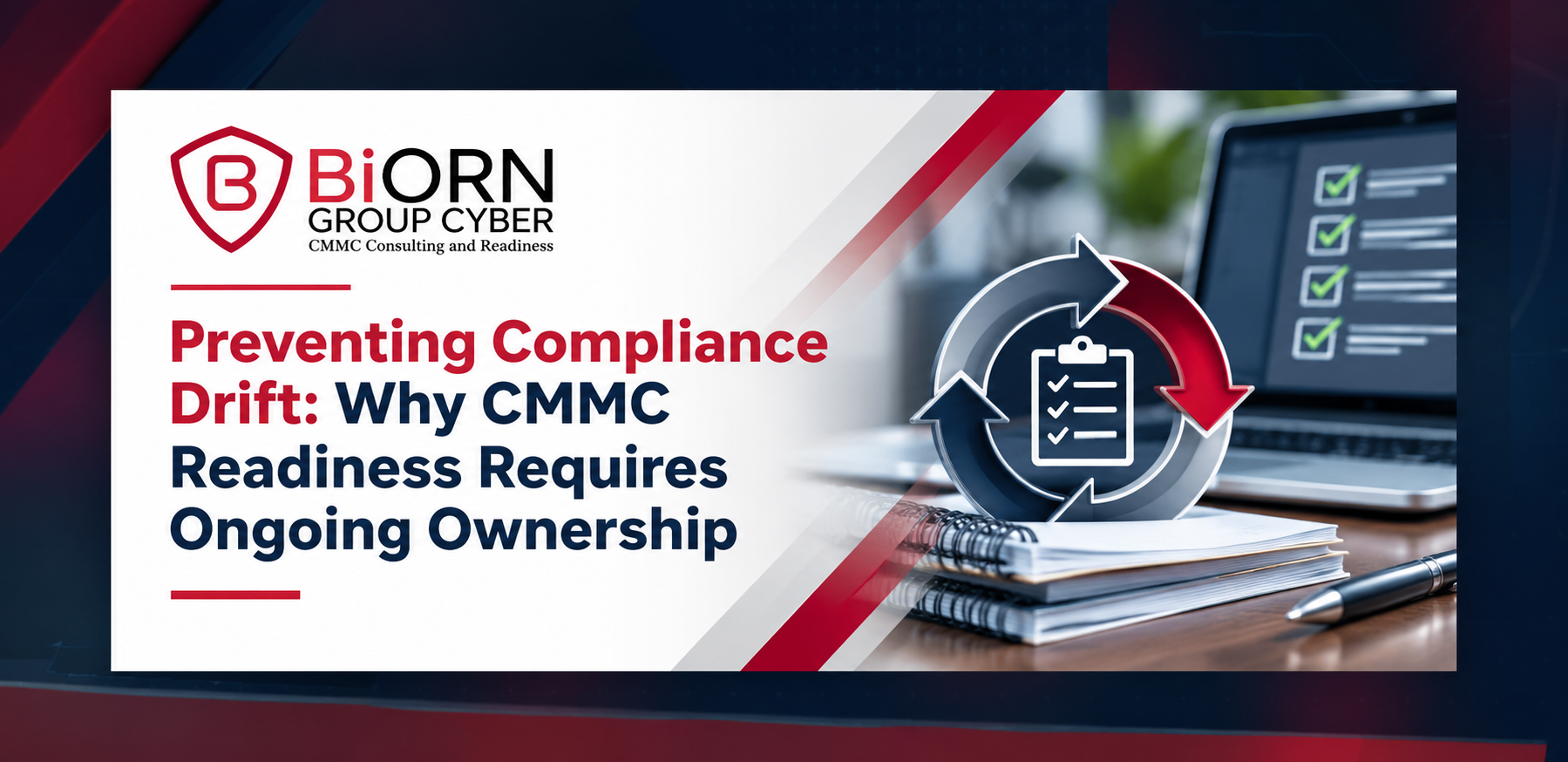

CMMC readiness is not something an organization achieves once and keeps automatically.
The environment continues to change after the initial readiness project ends.
Employees join or leave. Systems are replaced. Vendors are added. Cloud applications change. Responsibilities shift. Documentation becomes outdated. Evidence is stored in new locations—or is no longer retained at all.
None of these changes is unusual.
They are part of normal business operations.
But without ongoing ownership and review, normal changes can gradually create differences between what the organization says it does and what it actually does.
That gradual separation is often referred to as compliance drift.
Preventing it requires more than an annual policy review or a last-minute assessment-preparation project. It requires a repeatable operating rhythm for reviewing changes, maintaining safeguards, updating documentation, and preserving evidence.
During an initial readiness initiative, cybersecurity and compliance activities often receive focused attention.
Teams meet regularly. Policies are updated. Technical issues are corrected. Roles are discussed. Evidence is collected. Open items are tracked.
Then the project ends, and employees return to their regular priorities.
The organization may still have the same tools and documents, but the surrounding environment begins to evolve.
Over time:
None of these changes may appear significant by itself.
Together, however, they can weaken the organization’s readiness posture and make future validation more difficult.
Compliance drift often begins with ordinary business decisions.
Employees leave, join new departments, or assume additional responsibilities. Access permissions and documented responsibilities may not be updated at the same time.
Systems, cloud applications, configurations, and integrations are modified without reviewing how the change affects scope, documentation, safeguards, or evidence.
A provider begins or stops performing a relevant activity, but responsibility matrices, procedures, and evidence processes remain unchanged.
Employees develop a faster way to complete a task, share information, or approve access. The new workflow may never be reviewed or documented.
Policies, procedures, inventories, and diagrams are updated only when an assessment or customer request creates urgency.
Required activities occur, but the related records are not retained, reviewed, or connected to the applicable process.
A sustainable readiness program should be designed to detect these issues before they accumulate.
Every recurring cybersecurity or compliance activity should have a clearly identified owner.
Examples include:
The organization should also identify:
Ownership should be based on actual authority and operational responsibility.
Assigning every activity to “IT,” “management,” or “the compliance team” may create the appearance of accountability without giving anyone a clear obligation to act.
Documentation should not be viewed as a static collection of files that is revisited only before an assessment.
Policies, procedures, diagrams, inventories, and responsibility matrices describe how the organization expects its security program to operate.
When the environment changes, those records may need to change as well.
Documentation reviews should confirm whether each record:
The strongest documentation is not necessarily the longest.
It is the documentation that accurately reflects how the organization operates.
Waiting until immediately before an assessment to gather evidence creates avoidable risk.
Logs may expire. Employees may leave. Vendors may change platforms. Tickets may be archived. Older approvals may become difficult to locate.
Evidence collection should therefore be connected to the normal activity itself.
For example:
A repeatable evidence-retention process helps the organization preserve useful records as operations occur—not months later.
Operational changes should trigger a brief readiness-impact review.
This does not need to become an unnecessarily complex approval process.
It should simply prompt the right people to ask whether the change affects:
For example:
Connecting these questions to normal change-management activities helps the organization identify readiness impacts earlier.
Some corrective actions cannot be completed immediately.
They may require funding, procurement, vendor support, technical planning, or operational coordination.
Those items should remain visible and actively managed.
An open-item tracker should document:
Open items should be reviewed regularly so they do not disappear after the initial readiness project loses momentum.
The organization should also confirm that ownership remains current. A remediation item assigned to an employee who has changed roles is effectively unassigned.
Many defense contractors rely on MSPs, MSSPs, cloud providers, consultants, and technology vendors to support their security environments.
Ongoing readiness requires clarity regarding:
A service provider may carry out the technical activity, but the organization still needs visibility into whether the responsibility is being fulfilled.
Regular communication between internal stakeholders and external providers can reduce gaps caused by assumptions, incomplete handoffs, or undocumented changes.
Continuous readiness becomes more manageable when recurring activities follow a consistent schedule.
A sustainment rhythm may include:
Review open remediation items, personnel changes, access events, technical exceptions, and upcoming deadlines.
Review evidence, system changes, vendor responsibilities, inventories, and selected recurring security activities.
Conduct broader policy reviews, training, risk reviews, tabletop exercises, and readiness validation.
Review scope and documentation when significant systems, facilities, vendors, contracts, or business workflows change.
The appropriate schedule will depend on the organization’s environment.
The important point is to create a rhythm that can be sustained as part of normal operations.
Continuous CMMC readiness is ultimately an ownership and governance responsibility.
Technical safeguards must remain operational. Documentation must remain accurate. Evidence must remain available. Internal teams and external providers must understand their roles. Changes must be reviewed before they create larger inconsistencies.
Organizations that build these activities into their normal operating model are better positioned to identify drift early and maintain a more accurate understanding of their readiness posture.
Biorn Group Cyber helps defense contractors establish repeatable processes for reviewing changes, maintaining documentation, tracking remediation, organizing evidence, and coordinating ongoing responsibilities.